Pages

Monday, February 25, 2019

Venezuela: Backfire

VENEZUELA

The Backfire

Venezuelan President Nicolas Maduro’s latest move to block aid from entering the country looks to be spurring rather than deterring foreign intervention in the political crisis gripping Caracas.
After violent clashes between Venezuelan troops and opposition protesters over the weekend at the country’s borders resulted in at least four deaths and hundreds of injuries, US Vice President Mike Pence is set to announce “concrete steps” and “clear actions” to deal with the situation at a meeting with regional leaders in Bogota Monday and later Venezuelan opposition leader Juan Guaido, Reuters reported.
Following Maduro’s decision to deploy soldiers at border checkpoints to prevent aid from entering the country, skirmisheserupted in several locations, with government forces using tear gas and rubber bullets to disperse the crowds. As many as 60 Venezuelan soldiers also defected to the opposition.

Saturday, February 23, 2019

Venezuela: A Military Leader's Break With Maduro Hints At An Amnesty

https://worldview.stratfor.com/article/venezuela-military-leaders-break-maduro-hints-amnesty-deal-guaido-maduro

A Baker's True Colors Fly With Argentina Alfajores And Queer Tango

FOOD

A baker’s true colors fly with Argentine alfajores and queer tango

Andreas Ozzuna takes asado seriously. Which is surprising, because Ozzuna is actually a baker, the owner of Wooden Table Baking Co. and Wooden Table Cafe in Oakland, where the specialty is Argentinian sweets like alfajores and conitos.
But the importance of asado becomes clear in the center of Ozzuna’s lower Oakland hills backyard, which is gorgeously landscaped with large stepping stones and shrubs. For there sits an Argentine parrilla, a wood-fired grill hand-built from cement, bricks and a cast iron grate.
Ozzuna — who prefers the pronouns “they” and “them” — stands proudly at the parrilla on a sunny day that makes you forget it’s winter, patiently charring tri tip, a whole chicken with cut lemons and a dozen butternut squash halves, while friends chat happily over red wine and cheese. “The key to an asado is that it takes a really long time,” they say jokingly. “All day.”
  • Unlimited Digital Access for 99¢
  • Read more articles like this by subscribing to the San Francisco Chronicle
 SUBSCRIBE
In South America and Ozzuna’s native Argentina, asado refers to both the tradition of grilling meat over a fire, as well as the social event itself. “Asado is more a ritual than a simple food,” says Graciela Montaldo, professor of Latin American cultures at Columbia University in New York. “It’s a strong tradition from the Argentine pampas (the fertile South American lowlands), where gauchos would kill a cow in the middle of the desert to cook and eat.
“Today, asados are for special occasions, like weekends, birthdays and celebrations.”
While growing up in San Isidro, just outside of Buenos Aires, Ozzuna’s maternal grandfather worked as an asador, cooking asados for wealthy clients. Their grandparents would host family asados during holidays and celebrations, using animals raised on their land.
Here in the Bay Area, asado takes on even more importance for Ozzuna. For them, it’s a place for community, acceptance and queer tango.
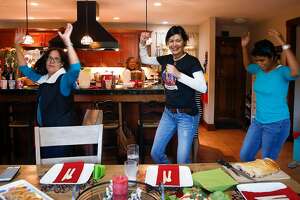
Above: Ozzuna (right rear) and friends toast at the asado in Oakland. Below: But the centerpiece of the evening is the alfajor cake, torta alfajor rogel.
Photo: Celeste Noche / Special to The Chronicle
Ozzuna immigrated to San Francisco in 1998 at age 28, partly because life as an LBGTQ person in Argentina was difficult. (Note: This has changed since they moved. Argentina legalized gay marriage in 2010, before the U.S.). Ozzuna was born female and came out as gay at age 15. At the time, they weren’t accepted by their family — another thing that has since changed. They currently identify as nonbinary and prefer gender-neutral pronouns.
“Back then, gay people didn’t exist in Argentina. You had to hide,” they explain. “I was arrested in a gay bar there and held for a while, so when I came to San Francisco and hung out in the Castro, I would hide when I saw cops. I was scared.”
It was here where Ozzuna found their chosen family, a group of queer women, including a few Argentine immigrants, their wife, Citabria, and their very social French bulldog, Olive. This monthly asado, Ozzuna explains, is a celebration of everything they were rejected for in Argentina. “It’s important to keep me going,” they say.
“All of us at the table are queer, many are immigrants and we’re intersectional,” says Ozzuna’s friend and fellow Argentine immigrant Julieta Barcaglioni.
For Ozzuna, no asado is complete without dessert. Their bakery business, Wooden Table, centers around alfajores, which they learned to bake from their abu (abuela, or grandma). Alfajores are Arabic in origin and spread from Spain. In Argentinia, they are often made from two soft shortbread cookies sandwiched with dulce de leche and rolled in coconut flakes. At the bakery, they like to experiment with flavors, including lemon ginger, snickerdoodles and chipotle chocolate.
A multilayered alfajor cake, torta alfajor rogel, is the centerpiece of dinner and asado with Andreas Ozzuna.
Photo: Celeste Noche / Special to The Chronicle
But today’s dessert is as Argentine as it gets: torta alfajor rogel. Essentially, it’s a giant, multilayered alfajor cake made with thin, crispy cookie discs and topped with dollops of Italian meringue, a nod to Argentina’s large Italian population. It’s the same recipe that Abu would make for birthdays and celebrations. It was nostalgia from growing up cooking and baking with Abu that inspired them to make the switch from geology to baking in 2011, so the cake is a fitting tribute to Abu.
To assemble the cake, Ozzuna cradles a massive pastry bag filled with pounds of dulce de leche. “It’s like a big, fat baby,” they say. “It’s a lot of dulce.”
“No such thing!” shouts Barcaglioni. Ozzuna’s arms start to shake from the strain of trying to extrude the dulce from the bag as Barcaglioni cheers them on, yelling “Esa! Esa!” Another friend, Florencia Manóvil, joins the cheering section as Ozzuna finishes the meringue topping and uses a small blowtorch to brown it.
Barcaglioni points to herself and Manóvil. “We are all Argentinian, immigrants and queer, we all immigrated in 1998, and it’s really special,” she says, highlighting the ways that Ozzuna has created an Argentine queer community in the Bay Area.
After dinner, an evening of tango at the home of Andreas Ozzuna of Wooden Table Baking Co.
Photo: Celeste Noche /Special to The Chronicle
The night ends the way it always does, with a bit of queer tango. Ozzuna met their wife, Citabria, in the local dance community, and she teaches lessons in a dance studio in their backyard. As guests change their shoes, Ozzuna’s friend Karen Lubisch talks about a Berkeley group she started seven years ago called Abrazo Queer Tango. Ozzuna and friends are members, but the concept of queer tango isn’t one I’m familiar with. Ozzuna’s friend and professional dance partner, Ginger Daniel, explains: “Queer tango is an opportunity to disrupt the heteronormative rules of tango, who leads and follows. We’re bucking the patriarchy and system through dancing.”
As Ozzuna leads with Citabria, several other female partners join, embracing and moving with the music.
Tango is more than a hobby for Ozzuna — it’s a passion. With Daniel, they won a bronze in tango in the Gay Olympics last year.
“There was a time when I didn’t feel comfortable announcing who I was as a business owner,” Ozzuna says. “But today, it’s on the window of the cafe: immigrant-run, LGBTQ owned. I’m proud of that.”
Wooden Table: 2300 Broadway, Oakland. www.woodentablebaking.com. 8 a.m.-7 p.m. Monday-Friday; 9 a.m. to 6 p.m. Saturday, and until 5 p.m. Sunday.
Leena Trivedi-Grenier is a freelance writer living in the Bay Area. Email: food@sfchronicle.com Twitter: @Leena_Eats

A guide to Argentine treats and rebellious pastries

Alfajor: This is the treat Wooden Table Baking Co. is known for. Arabic in origin, spread by Spain and l

Friday, February 22, 2019

President Bolsanaro Tackles Brasil's Pension Problems

https://www.economist.com/the-americas/2019/02/23/jair-bolsonaro-tackles-brazils-pensions-problem?cid1=cust/dailypicks/n/bl/n/20190221n/owned/n/n/dailypicks/n/n/na/205504/n

Tuesday, February 19, 2019

Cuba: A Capricious Coquette

CUBA

A Capricious Coquette

Britain’s Prince Charles is scheduled to visit Cuba in the spring, a rare visit of a royal to a country whose communist ideology opposes monarchy. (His ancestors avoided visiting the Soviet Union because the Bolsheviks murdered their relatives, the Romanovs, in the Russian revolution.)
Charles will see vintage cars and, as the Guardian wrote, likely eat cassava bread – though maybe not “Moros y Cristianos,” or Moors and Christians, a politically incorrect term for rice and beans.
The trip comes as Cuba undergoes momentous changes.
On Feb. 24, Cubans will vote on a new constitution. The proposed document will retain the supremacy of the Communist Party and state control of the economy. However, it will legalize private property and businesses that have been popping up throughout the Caribbean island in recent years, open the door to more foreign investment, and potentially hasten the acceptance of same-sex marriage, Reuters reported.
Even before the former dictator Fidel Castro fell ill and died in 2016, Cuban officials had been loosening their control of the economy and civil society. Acknowledging the changes but stressing the country has not yet entirely sloughed off its totalitarian past, the United States opened an embassy on the island in 2015.
To be clear, the Cuban government is still oppressive.
Security agents have arrested and mistreated activists who oppose the new constitution because, they argue, it legitimizes the current government of Raúl Castro, Fidel’s 87-year-old brother, who stepped down as president last year but still wields power as head of the Communist Party.
“During the detention they punched me in the stomach, took me outside with handcuffs put on really tight, shoved me around and hit me on the head a couple of times,” dissident José Daniel Ferrertold the Miami Herald. “They told me clearly that it was a response to the campaign against the constitution.”
In an op-ed in the Miami Herald, Outreach Aid to the Americas President Teo Babun also argued that the new constitution fails to enshrine freedom of religion in the country.
The constitution symbolizes the contradiction at the heart of Cuban society, wrote Elizabeth Gonzalez of the Americas Society/Council of the Americas.
It would empower President Miguel Díaz-Canel – widely viewed as Castro’s successor in waiting – to make further changes. Díaz-Canel, 58, is a “Twitter personality and proponent of technological innovation,” wrote Gonzalez. But he also promotes the hashtag #WeAreContinuity, emphasizing how his designs are in keeping with the ideas of older revolutionaries.
Díaz-Canel, for example, recently said the new constitution would defend Cuba’s “sovereignty, independence and dignity,” wrotePrensa Latina, the country’s state-run news service. He’s not talking about democracy and civil rights.
Still, the winds of change are blowing in Cuba. What they bring in and out of the country could be historic.

Thursday, February 14, 2019

Guatemala: Crying For Justice

GUATEMALA

A Cry for Justice

Indigenous survivors of war crimes committed during Guatemala’s 36-year civil war filed an injunction Wednesday seeking to block an amnesty bill that would allow the soldiers who raped them – as well as other war criminals — to go free.
Thirty-six women of the Maya Achi group filed the injunction to try to prevent the amnesty bill from moving forward and stopping the ongoing trial against six men accused of raping them in a military base in the early 1980s, Al Jazeera reported. If the amnesty bill passes, their case is among many that will be closed.
Initially proposed in 2017, the bill passed its first reading and vote last month, the news channel said. A second of three readings was on the agenda for the Wednesday session of Congress, but it was bumped from the schedule and a new date has not yet been announced.
The bill would offer a blanket amnesty to more than 30 men convicted of war crimes, as well as those in pre-trial detention, and put a stop to current and future cases.
Around 200,000 people were killed and another 40,000 were disappeared during the conflict between the army and leftist guerillas. More than 80 percent of those killed were indigenous Mayan civilians.

Tuesday, February 12, 2019

Mexico: A Land Of Waiting

CENTRAL AMERICA

A Land of Waiting

Wearing his red and white “Make Tijuana Great Again” hat, Mayor Juan Manuel Gastélum recently described Central American migrants as “pot smokers, bums and bad people,” according to Fox News.
He has refused to apologize for his incendiary remarks and has appealed a Mexican court ruling barring him from making more derogatory comments about migrants, the San Diego Union-Tribune reported.
The “Trump of Tijuana,” as Slate called him, has made his stance on the thousands of migrants who have stopped in his city on their way to the United States a major plank in his re-election bid.
The subject is probably a better talking point on the campaign trail than the 2,009 homicides that San Diego’s local NBC affiliate saidoccurred in the border town last year, an increase from around 1,650 in 2017.
In a sense, the migrants’ presence has stimulated crime and corruption in Mexico, USA Today reported. Turned away at the border, they desperately scrounge up around $5,000 per person to pay smugglers to bring them into the US illegally while avoiding criminal gangs who might kidnap and ransom them.
The American policy of “Remain in Mexico” – currently applied only at the San Ysidro border crossing between Tijuana and San Diego – sends Central American asylum seekers back to the Mexican city to stay as authorities decide their applications. The policy, officially called the Migration Protection Protocols, could make the crisis south of the border worse as more people arrive, Al Jazeera argued.
The problem is already ballooning in Piedras Negras, a Mexican town across the Rio Grande from Eagle Pass, Texas. Customs and Border Protection officials can only process 20 people a day from Piedras Negras, NBC News reported. A total of 1,800 asylum seekers are sleeping in a shelter as they await processing.
Maverick County Sheriff Tom Schmerber recently visited the shelter. He and others were readying for any potential breakdowns in public safety, in case the migrants in the shelter grow restive.
Last month, signaling a commitment to migrants’ rights, Mexican President Andrés Manuel López Obrador offered humanitarian visas to citizens from crime-ridden Central American countries like El Salvador and Honduras, allowing them to travel and work around Mexico.
A caravan of 12,000 Central Americans set out for Mexico soon after the open-door policy was announced. The government responded by shuttering the program, noted United Press International.
Now, many migrants feel as if the US and Mexico are “playing with their lives,” wrote PRI.
While some migrants are confused or shocked over the new and sometimes-flip-flopping policies, most understand they will be waiting, and waiting, and waiting.
“We obviously would rather be in the United States and waiting, but if we have to wait, we will,” a Salvadoran named Juli, 24, told PRI. “The gangs threatened us, and all five of us living in the house left within a day. What’s our alternative?”