South America has been a special part of my life for four decades. I have lived many years in Brasil and Peru. I am married to an incredible lady from Argentina. I want to share South America with you.
Brazil’s lower house of Congress on Wednesday approved a bill to overhaul the country’s pension system, setting it up for likely passage in the Senate in September.
Under debate for more than a year, the reform is a key step to reducing the country’s massive budget deficit and an essential part of President Jair Bolsonaro’s plans for revitalizing the flagging economy, Reuters reported.
According to Bolsonaro’s government, the overhaul will save the treasury 933 billion reais ($235 billion) over the next decade by raising the minimum retirement age and reducing some workers’ benefits.
Last month, the government posted a primary fiscal deficit of 12.7 billion reais ($3.35 billion), the agency reported separately. The country’s gross debt stood at 78.7 percent of gross domestic product and its net debt rose to 55.2 percent of GDP.
Under some circumstances, that’s not a terrible ratio, but the eighth largest economy in the world is still reeling from a commodities bust that brought its soaring 7.5 percent GDP growth in 2010 to -3.6 percent in 2016, noted financial website thebalance.com. And its sovereign bonds are rated below investment grade (or “junk”).
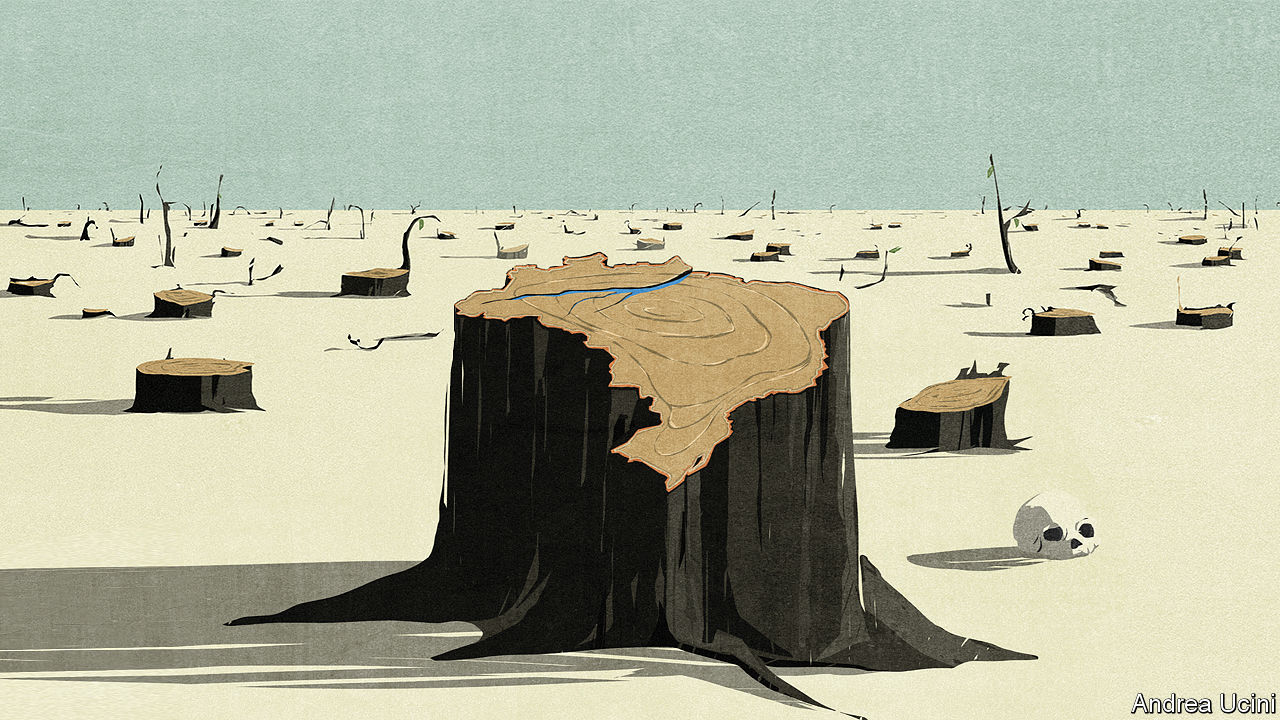
Although its cradle is the sparsely wooded savannah, humankind has long looked to forests for food, fuel, timber and sublime inspiration. Still a livelihood for 1.5bn people, forests maintain local and regional ecosystems and, for the other 6.2bn, provide a—fragile and creaking—buffer against climate change. Now droughts, wildfires and other human-induced changes are compounding the damage from chainsaws. In the tropics, which contain half of the world’s forest biomass, tree-cover loss has accelerated by two-thirds since 2015; if it were a country, the shrinkage would make the tropical rainforest the world’s third-biggest carbon-dioxide emitter, after China and America.
Nowhere are the stakes higher than in the Amazon basin—and not just because it contains 40% of Earth’s rainforests and harbours 10-15% of the world’s terrestrial species. South America’s natural wonder may be perilously close to the tipping-point beyond which its gradual transformation into something closer to steppe cannot be stopped or reversed, even if people lay down their axes. Brazil’s president, Jair Bolsonaro, is hastening the process—in the name, he claims, of development. The ecological collapse his policies may precipitate would be felt most acutely within his country’s borders, which encircle 80% of the basin—but would go far beyond them, too. It must be averted.
Humans have been chipping away at the Amazon rainforest since they settled there well over ten millennia ago. Since the 1970s they have done so on an industrial scale. In the past 50 years Brazil has relinquished 17% of the forest’s original extent, more than the area of France, to road- and dam-building, logging, mining, soyabean farming and cattle ranching. After a seven-year government effort to slow the destruction, it picked up in 2013 because of weakened enforcement and an amnesty for past deforestation. Recession and political crisis further pared back the government’s ability to enforce the rules. Now Mr Bolsonaro has gleefully taken a buzz saw to them. Although congress and the courts have blocked some of his efforts to strip parts of the Amazon of their protected status, he has made it clear that rule-breakers have nothing to fear, despite the fact that he was elected to restore law and order. Because 70-80% of logging in the Amazon is illegal, the destruction has soared to record levels. Since he took office in January, trees have been disappearing at a rate of over two Manhattans a week.
The Amazon is unusual in that it recycles much of its own water. As the forest shrivels, less recycling takes place. At a certain threshold, that causes more of the forest to wither so that, over a matter of decades, the process feeds on itself. Climate change is bringing the threshold closer every year as the forest heats up. Mr Bolsonaro is pushing it towards the edge. Pessimists fear that the cycle of runaway degradation may kick in when another 3-8% of the forest vanishes—which, under Mr Bolsonaro, could happen soon. There are hints the pessimists may be correct (see Briefing). In the past 15 years the Amazon has suffered three severe droughts. Fires are on the rise.
Brazil’s president dismisses such findings, as he does science more broadly. He accuses outsiders of hypocrisy—did rich countries not fell their own forests?—and, sometimes, of using environmental dogma as a pretext to keep Brazil poor. “The Amazon is ours,” the president thundered recently. What happens in the Brazilian Amazon, he thinks, is Brazil’s business.
Except it isn’t. A “dieback” would directly hurt the seven other countries with which Brazil shares the river basin. It would reduce the moisture channelled along the Andes as far south as Buenos Aires. If Brazil were damming a real river, not choking off an aerial one, downstream nations could consider it an act of war. As the vast Amazonian store of carbon burned and rotted, the world could heat up by as much as 0.1°C by 2100—not a lot, you may think, but the preferred target of the Paris climate agreement allows further warming of only 0.5°C or so.
Mr Bolsonaro’s other arguments are also flawed. Yes, the rich world has razed its forests. Brazil should not copy its mistakes, but learn from them instead as, say, France has, by reforesting while it still can. Paranoia about Western scheming is just that. The knowledge economy values the genetic information sequestered in the forest more highly than land or dead trees. Even if it did not, deforestation is not a necessary price of development. Brazil’s output of soyabeans and beef rose between 2004 and 2012, when forest-clearing slowed by 80%. In fact, aside from the Amazon itself, Brazilian agriculture may be deforestation’s biggest victim. The drought of 2015 caused maize farmers in the central Brazilian state of Mato Grosso to lose a third of their harvest.
For all these reasons, the world ought to make clear to Mr Bolsonaro that it will not tolerate his vandalism. Food companies, pressed by consumers, should spurn soyabeans and beef produced on illegally logged Amazonian land, as they did in the mid-2000s. Brazil’s trading partners should make deals contingent on its good behaviour. The agreement reached in June by the eu and Mercosur, a South American trading bloc of which Brazil is the biggest member, already includes provisions to protect the rainforest. It is overwhelmingly in the parties’ interest to enforce them. So too for China, which is anxious about global warming and needs Brazilian agriculture to feed its livestock. Rich signatories of the Paris agreement, who pledged to pay developing ones to plant carbon-consuming trees, ought to do so. Deforestation accounts for 8% of global greenhouse-gas emissions but attracts only 3% of the aid earmarked for combating climate change.
The wood and the trees
If there is a green shoot in Mr Bolsonaro’s scorched-earth tactics towards the rainforest, it is that they have made the Amazon’s plight harder to ignore—and not just for outsiders. Brazil’s agriculture minister urged Mr Bolsonaro to stay in the Paris agreement. Unchecked deforestation could end up hurting Brazilian farmers if it leads to foreign boycotts of Brazilian farm goods. Ordinary Brazilians should press their president to reverse course. They have been blessed with a unique planetary patrimony, whose value is intrinsic and life-sustaining as much as it is commercial. Letting it perish would be a needless catastrophe. ■
Paraguay’s President Mario Abdo thanked lawmakers for allowing a resolution of a scandal related to a hydropower deal with Brazil “that does not break the democratic process” on Thursday after the legislators backed down from a threat to impeach him.
Facing the threat of impeachment and reeling from the resignations of his foreign minister and three other officials, Abdo scrapped the deal and apologized for the way the scandal had been handled, Reuters reported.
“Whoever has to be accountable for his misconduct will be accountable,” Abdo said in a message to the nation.
Under a deal that was signed in May but not revealed until last week, the two countries had agreed to establish a schedule for the purchase of energy from the Itaipu dam until 2022. But Paraguayan lawmakers were outraged by the terms, which some experts said would cost one of South America’s poorest countries $200 million, Agence France-Presse reported.
The two countries are partners in the hydropower project – which ranks as the world’s largest – but Paraguay’s economy depends upon it.
Costa Rica and Panama teamed up to raid dozens of locations and arrest nearly 50 people linked to an international network of human traffickers Tuesday.
The network is believed to be involved in smuggling people from Africa, Asia and the Caribbean through Central America and toward the United States, prosecutors said, according to Reuters.
Costa Rican authorities raided 36 facilities near the country’s borders with Panama and Nicaragua, arresting 37 people, while in Panama federal police arrested another 12 people allegedly connected to the same network.
Costa Rica has documented 249 migrants who were transported by the smuggling ring, but “there have been many more,” said Stephen Madden, deputy director of Costa Rica’s migration police.
The news agency cited a Costa Rican police report as saying that the smugglers transported migrants overland and by sea via the port of Puerto Soley to Honduras, where other organizations based in Guatemala picked them up for transport into Mexico and as far as the southern border of the United States.
Almost 50 million people in Argentina, Uruguay and Paraguay lost power in an area four times as large as Texas. A month later, officials told the Associated Press that “improper reprogramming” in a major transmission line was to blame.
For years, Argentine utilities didn’t increase rates. Repairs, maintenance and new investments lagged as the grid wore out, the New York Times reported.
Electricity prices have increased under President Mauricio Macri, a business-oriented conservative who took office in 2015 and now is seeking re-election in October.
But the increases were unpopular. Argentina is in deep recession. Inflation is over 50 percent. Unemployment is 10 percent. Amid popular discontent earlier this year, Macri imposed a price freeze, Bloomberg wrote.
It’s ironic that the electricity grid failed. Macri has had plenty of ribbon cuttings on his schedule in the months leading up to the election, reported Al Jazeera. He’s been building new roads, bridges, subway extensions, rail lines, and other projects in a bid to boost the country’s flagging economy.
“There is obviously a government decision to increase expenditure in public works above what was budgeted, at least during this time of the year,” Argentine economist Rafael Flores told the Qatar-based news service.
In October, Macri faces Alberto Fernández, a center-left Peronist who wants to renegotiate the South American country’s deal with the International Monetary Fund for $57 billion to finance its economy, Reuters reported.
But Fernández has chosen former President Cristina Fernández de Kirchner as his running mate. The wife of the late former President Nestor Kirchner, she took office in 2007 and lost to Macri in 2015 amid corruption scandals – but then won a seat in the country’s senate.
“During those eight years, she nearly ran the country into the ground, in part by playing to voter frustration by declaring war on a group of foreign lenders,” opined foreign affairs pundit Ian Bremmer in Time magazine. “Her government manipulated economic statistics. Graft in politics and business was widespread. Cristina faces several ongoing corruption cases.”
Argentines face a choice in the upcoming election, Bremmer concluded: They could stick to the hard reforms that have yet to pay off but could yield a much better quality of life in the future. Or they could go back to an “ugly past.”
Corruption investigators face uphill battles in Argentina, wroteAmericas Quarterly. Hunger is a major problem, reported El País, a Spanish newspaper.
There are a lot of problems that need fixing. Many hope that whoever wins in October gets busy with solving them, not politics.
Fighting between rival gangs at the Altamira prison in northern Brazil left at least 52 prisoners dead on Monday – 16 of them decapitated.
The death toll could rise when authorities have searched all areas involved, state prisons chief Jarbas Vasconcelos said at a news conference, according to the Associated Press.
The fighting began around 7 a.m. Monday between two criminal gangs, Comando Vermelho and Comando Classe A, when members of Comando Classe A set fire to the pavilion that houses the rival gang, prison authorities said.
The fire spread rapidly and prevented police from entering the building for about five hours, during which carnage reigned.
Such violence is not uncommon in Brazil’s prison system. A similar series of riots killed 55 inmates in several prisons in the neighboring state of Amazonas in May, for instance, and in 2017 more than 120 inmates died in prisons across several northern states when rival gangs clashed over control of drug-trafficking routes, according to the Associated Press.